Supporting Student Mental Health Without Over-Identifying: A Tiered Approach That Works

Something worth paying attention to is happening across U.S. schools: even as overall enrollment declines, the number of students identified for special education services keeps climbing.
About 8.2 million students qualified for IDEA services in 2024—a 12.6% increase from pre-pandemic levels. Education experts point to several contributing factors, including heightened attention to children's mental well-being.
That attention is definitely not a bad thing. But it raises an important question for school and district leaders: are we building systems that identify and meet student needs early, or ones that funnel students into increasingly intensive placements as a first response?
The distinction matters enormously—for students, for families, and for sustainable school design.
The Inverted Pyramid Problem
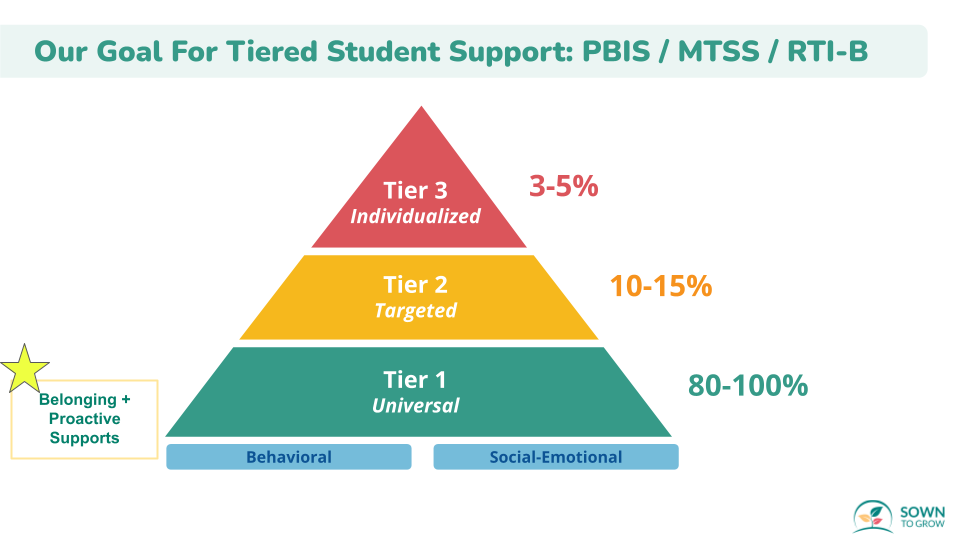
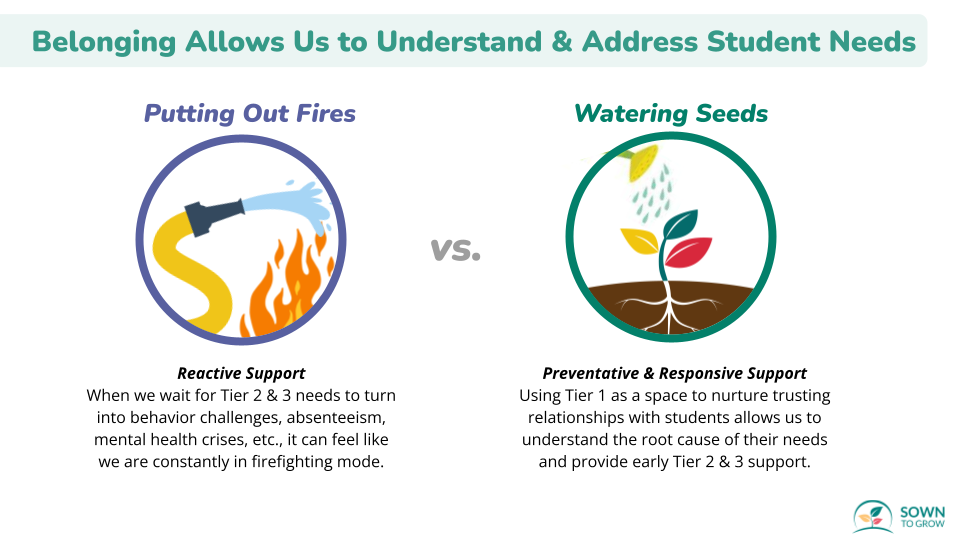
In a healthy MTSS model, 80–100% of students have their needs met through strong Tier 1 universal supports, with smaller groups requiring Tier 2 or Tier 3 intervention. But many schools are operating with an inverted version of this picture.
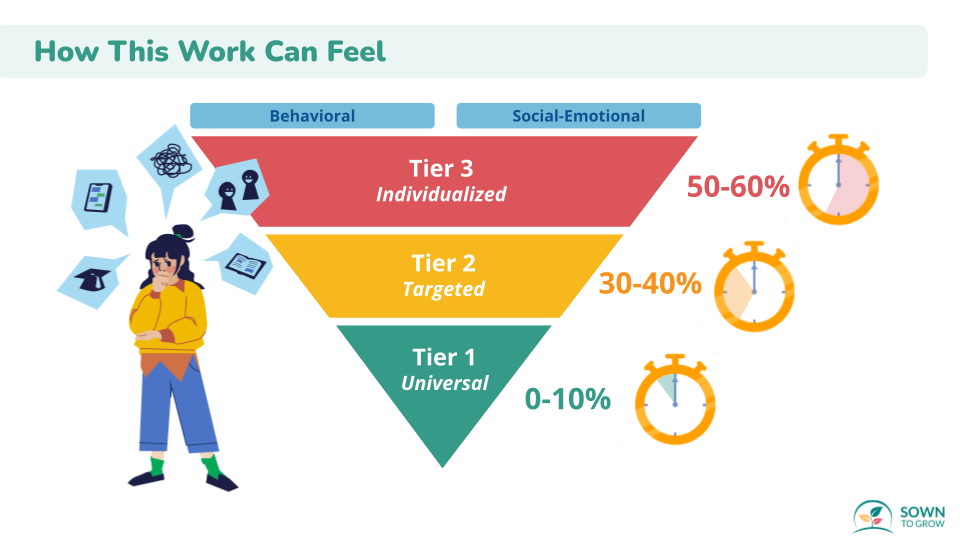
When support professionals spend most of their time responding to crises—behavioral emergencies, mental health escalations, chronic absenteeism—they have little bandwidth left to build the proactive Tier 1 systems that would reduce those escalations in the first place.
As Dr. Shai Fuxman of the Massachusetts Social, Emotional, and Behavior Academy has noted, "MTSS is about a single, cohesive and comprehensive system with a lot of different pieces that have to work together."
When schools skip the foundation to fight fires, the system cannot offer students support with the highest level of speed or quality.
Why Tier 1 Is Where Prevention Lives
If we wait for student needs to appear as behavioral challenges, failing grades, or absences, we've already missed our best window to intervene. Those are symptoms. Underneath them lie a student's sense of belonging, their emotional well-being, and their perception of whether any adult in the building genuinely cares about them.
Research confirms what educators already know: students who feel connected to a trusted adult at school are 19 percentage points more likely to be regular attenders, experience up to 35% fewer course failures, and are significantly more likely to graduate. Belonging is not just a warm and fuzzy feeling—it is necessary infrastructure to any school's success.

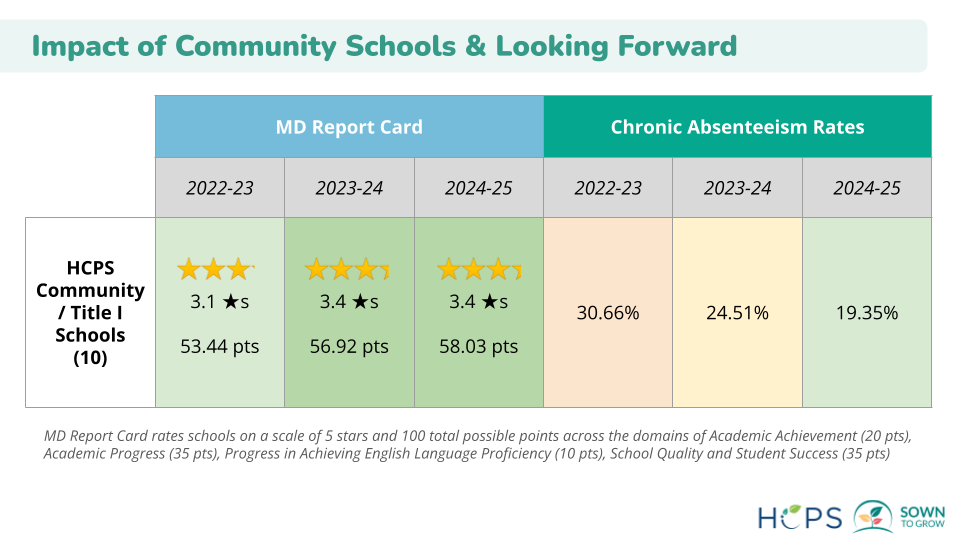
Harford County Public Schools (HCPS) in Maryland has built their student support model on this insight. Their community schools network grew from 2 schools in 2020 to 17 today, with belonging and proactive relationship-building embedded into Tier 1.
The result is measurable: HCPS Community/Title I schools reduced chronic absenteeism from 30.66% in 2022–23 to 19.35% in 2024–25. Strong universal supports don't just help students—they protect the integrity of the whole tiered system by ensuring students who reach Tier 2 and Tier 3 genuinely need that level of care.
Listening as a Data Strategy
One of the most underutilized tools in student mental health is also one of the simplest: asking students how they're doing, consistently, and actually using what they share. Harford County integrated weekly check-ins into their Tier 1 practice using Sown To Grow.
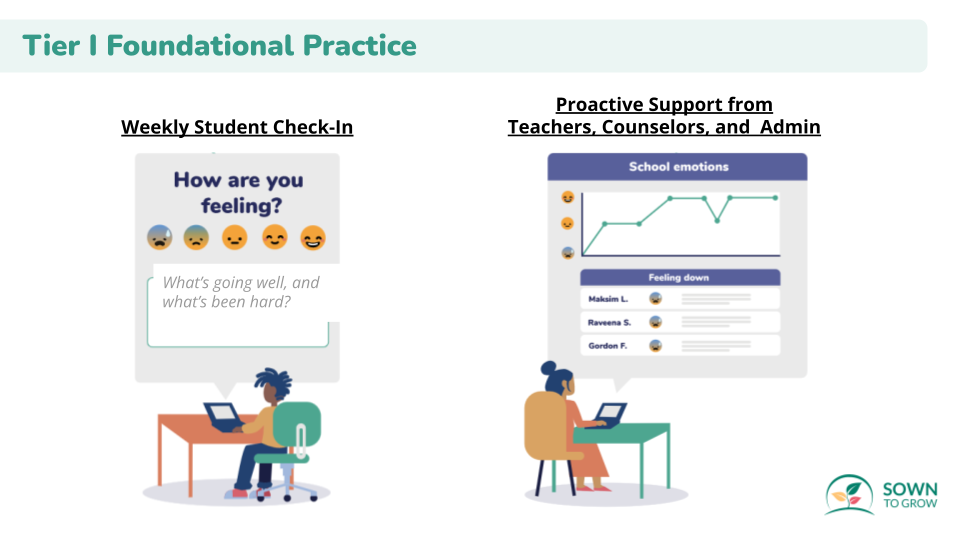
In this simple, five-minute routine, students respond to brief prompts about how they're feeling and what's been hard, and that data flows in real time to educators and support staff who can see patterns across classrooms, grade levels, and the district. This creates early visibility into needs that might otherwise stay hidden until they become crises—HCPS addressed 153 student alerts in a single year through this approach.
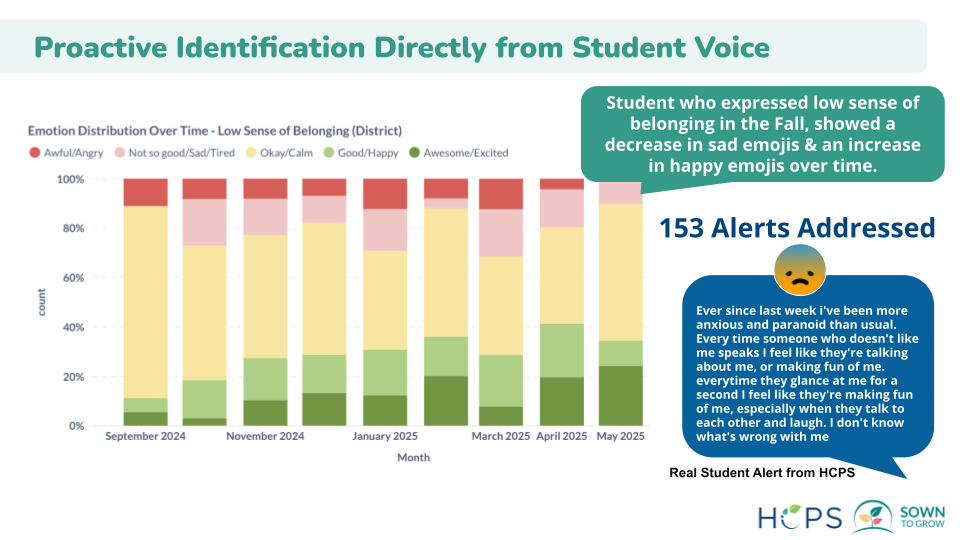
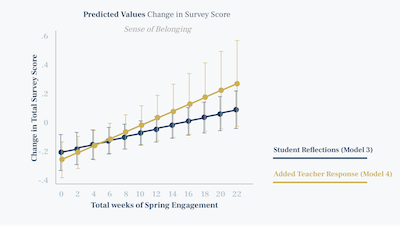
What makes it work is the design logic: students are identified through their own voice—their reflections are their real-time feelings—not a behavioral incident that could have been prevented. Research on the check-in model also found that when teachers responded consistently to student reflections, students showed greater improvement in their sense of belonging over time. The connection itself becomes the intervention.
A Pathway, Not a Pipeline
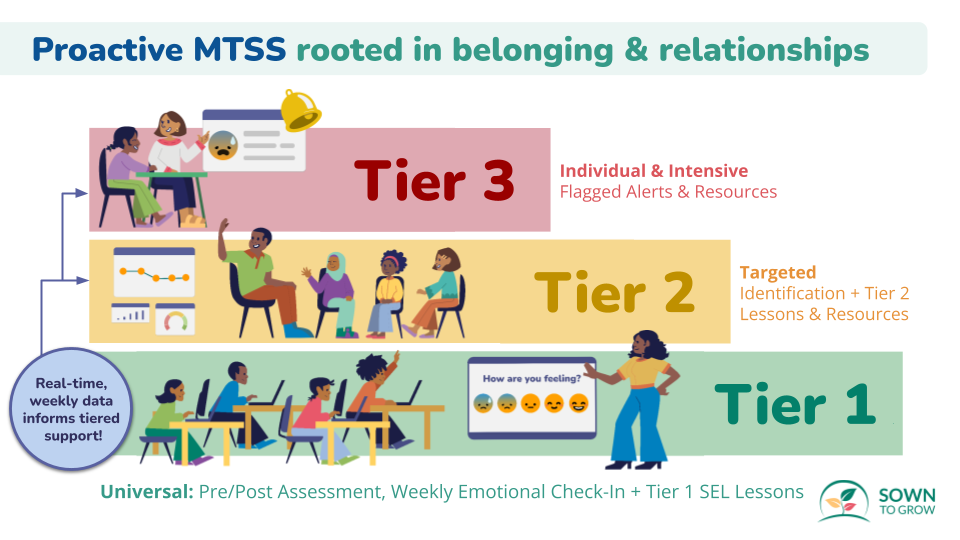
The goal of a tiered mental health approach isn't to move students efficiently toward more intensive services. It's to match the right support to the right student at the right time—and prevent unnecessary escalation wherever possible.
The irony of under-investing in Tier 1 is that it increases demand at every other tier. What might have been addressed through a counselor check-in becomes a full crisis response. What might have been a small-group intervention becomes a special education referral.
As Bonnie Lipton, a public health educator and MTSS expert, has put it, "Taking stock of existing data can help pinpoint the elements of your MTSS efforts that need additional resources so you can decide where to focus your efforts."
Schools ready to shift their approach might start with a few honest questions:
- How often are we hearing directly from students?
- When we do, what happens next?
- Are support staff spending most of their time responding—or do they have capacity to be proactive?
Answering those questions is the first step. Building systems that change the answers is the work. Every caring interaction a student has with a trusted adult compounds over time—reducing the likelihood of crisis and increasing students' long-term chance of thriving.
---
Interested in how Sown To Grow supports proactive, student-centered MTSS implementation? Book a conversation with our team.
.png)
.png)
.png)
.png)
.png)