Making Every Student Known

In every classroom, students carry stories that educators cannot see. A student who has stopped raising their hand may be worried about falling behind. A student who seems distracted may be navigating a challenge outside of school. Another may be making quiet progress, but has not yet had the opportunity to name it or celebrate it. We work hard to know our students, but we do not always understand the experiences beneath the behaviors, emotions, and patterns we observe each day.
I spent years as Director of School Social Work in Metro Nashville Public Schools, and I can tell you that the students I worried about most were rarely the ones who came to my attention first. In busy schools, we naturally respond to what we can see and hear. Students who speak up, ask for help, or show visible signs of struggle are easier to notice. Those who are quiet, compliant, multilingual, uncertain, or simply not ready to speak up can be easier to miss.
But being quieter doesn't mean having less to say. What those students often need is a regular invitation to share, and a trusted adult who is ready to listen.
Making student voice a Tier 1 practice
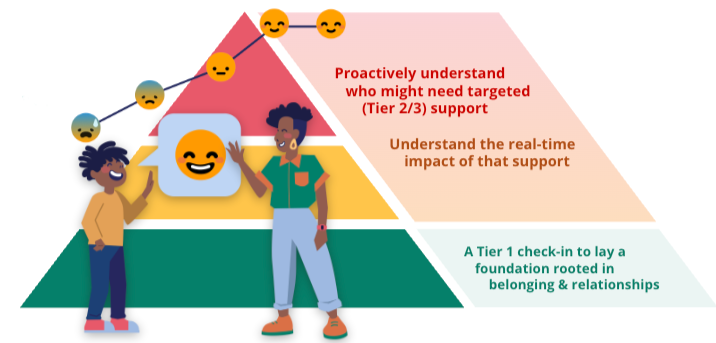
That conviction is what led us to build the Navigator program in Metro Nashville Public Schools. The idea was simple, even if the logistics weren't: each of our students would be paired with a caring adult in their building who checked in with them regularly and stayed with them over time. Not only students on a caseload, or those already flagged for support. Every student.
Too often, we turn to student voice only after a concern has emerged: a referral, a change in behavior, a drop in attendance or grades. By then, we are working to understand something that has already taken hold.
A Tier 1 approach starts earlier. Every student has a regular opportunity to share what they are experiencing, not because something is wrong, but because knowing students is part of supporting them well.
A strong student voice routine is:
- Consistent: Reflection becomes a normal part of school rather than a reaction to a problem.
- Accessible: Every student has a way to share, even when they don't feel comfortable speaking up.
- Actionable: Educators can spot patterns, respond to individual needs, and connect students to the right support.
- Supportive: Students understand that sharing is meant to help them grow, not to label them.
The challenge is making that practice possible at scale. Paper journals, exit tickets, and periodic surveys can capture important moments, but they are difficult to sustain across hundreds or thousands of students. They also make it harder to recognize patterns over time or notice when something has changed.

This is where technology can play a meaningful role.
Sown To Grow is fundamental to how Navigator works in MNPS. Students spend about five minutes each week checking in and reflecting on how they are doing. Their responses give educators a window into experiences they may not otherwise see. Teachers can see responses in one place, along with patterns over time, and can respond directly. Counselors and designated support staff can monitor areas of concern and follow established protocols. Leaders can see where students are thriving and where attention is needed.
Instead of asking educators to gather one more set of information, Sown To Grow brings student voice into a workflow they can actually use. Instead of asking students to spend more time on screens, it keeps the interaction brief and purposeful. What the technology does is help a caring adult know where to look, and create more opportunities to build relationships and offer the support that can make a difference.
What we’re learning
When students are given a consistent space to share, they use it. Teachers using Sown To Grow report an 18% increase in students opening up to them compared with before they began using the platform.
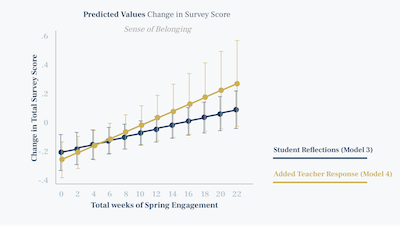
The effects reach further. An independent analysis by Huebert Impact Research examined 26,763 students across 299 schools and 37 districts during the 2023–24 school year. Students who reflected consistently showed statistically significant growth in five of six social-emotional competencies, including sense of belonging, with the strongest effects among students who continued reflecting through the spring.
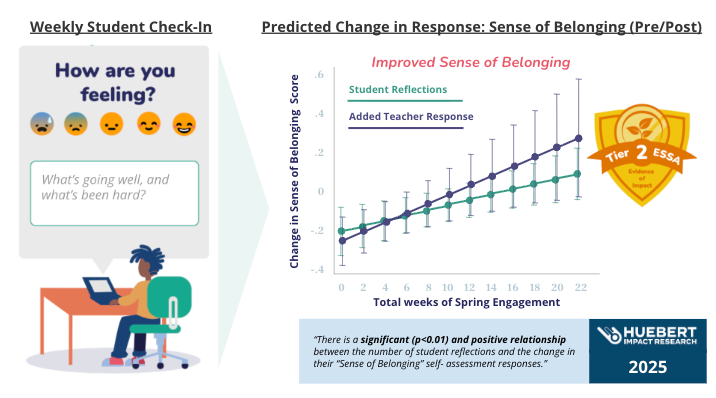
Among elementary students, belonging grew more when teachers responded to those reflections, a useful reminder that the check-in is the beginning of the exchange, not the whole of it.
That is the part worth carrying forward. A weekly check-in is a small thing. But when every student has one, and an adult on the other end of it, the result is more than better information. It is a school where every student can feel known.
Feeling known makes all the difference. An analysis of chronic absenteeism rates in California school districts between 2022 and 2025 demonstrates that schools using Sown To Grow’s weekly check-in outpace other schools in the state in reducing chronic absenteeism. These findings point to the potential of a simple, consistent practice: when schools create regular opportunities to listen to students and respond to what they share, they strengthen the relationships that keep students engaged.
Every voice should lead to connection
Students should not have to be struggling before adults try to understand what they need. Every student deserves regular opportunities to share what they are experiencing, hoping for, and needing.
I came to Sown To Grow because I had seen what this practice makes possible, and I wanted more schools to have it. Making every student known does not mean knowing everything about every student. It means creating the conditions for students to be seen, heard, and understood, and giving the adults who care about them the information they need to act.
That is where technology belongs: making it possible to ask every student consistently, hear from all of them, act on what they share, and keep it in service of their growth.
.png)
.png)
.png)
.png)
.png)