Trust Comes First: How Sown To Grow Protects Student Data
How are you doing? It’s a question students hear every day—in the hallway, at the start of class, or on their way out the door. More often than not, it’s a passing pleasantry, with “fine” as the typical answer. What’s less common is having a trusted adult who takes the time to dig deeper and create space for students to share how they’re really doing.
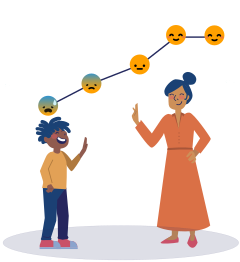
That’s what Sown To Grow is designed to support. When students check in, they choose an emoji and can share how they're feeling and what's going on in their lives. These check-ins give students a safe space to express themselves and connect with adults who can support them, even when they may not feel comfortable saying those things out loud.
But students will only share if they trust where their words are going. That trust has to be earned, and it starts with how we handle their data.
As the Director of Operations at Sown To Grow, much of my job is answering questions from schools and districts about student data. What do you collect? Who can see it? What happens to it? These are the right questions to ask when it comes to kids and technology. Here's how we answer them.
What we collect (and what we don't)
We collect only what we need to support students. If we don't need it, we don't collect it.
We use a student's name, email, school, class, and grade level. This information enables students to sign in, allows teachers to identify whose reflections they're seeing, and ensures each student is connected to the right teachers and reflection prompts.
We don't collect birth dates, home addresses, demographic data, grades, or behavior records. While these types of information can play an important role in understanding and supporting students, they're not necessary for students to check in and share their experiences through Sown To Grow.
For districts using Clever or ClassLink, limiting data is even easier, because the district controls exactly what's shared with us. We can narrow it down to homeroom classes only: one class per teacher and one per student.
Less really is more here. Every piece of data a company holds is another it must protect. Limiting what we collect is one of the simplest ways to reduce risk.
Privacy: the commitments we hold ourselves to
Student data exists in Sown To Grow for the sole reason of helping schools support students. We never sell student data or use it for advertising or marketing.
Before any connection is made, we complete a Data Privacy Agreement with the district and share documentation of our alignment with the National Institute of Standards and Technology (NIST) Cybersecurity Framework, which guides how we manage and protect data. Our practices also align with key federal student privacy laws including FERPA, COPPA, and CIPA.
Schools and districts stay in control of their students' information. Their privacy requirements take precedence when more stringent than ours, and we delete data upon district request. While student data may be stored by Sown To Grow, it belongs to the schools and students we serve.
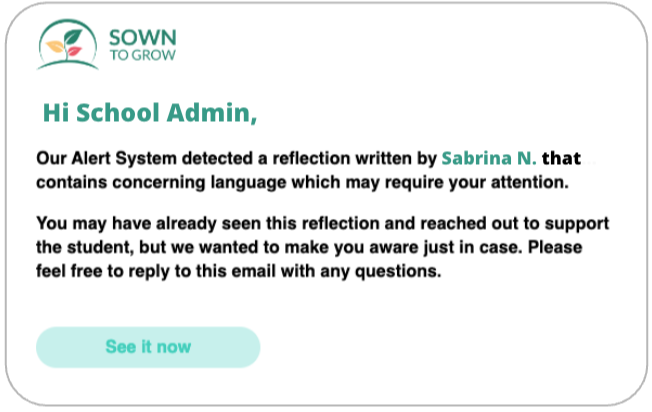
That protection extends to student alerts as well. When a reflection raises a concern, only designated staff receive an email notification, and the alert does not include the student's written response. Staff must sign in to view the reflection, and trained school personnel determine the appropriate response based on their own policies.
We don't ask schools to take our word for it. Sown To Grow has earned the Common Sense Privacy Program’s Verified Seal, an independent review of how we handle student privacy.
These same principles guide how we approach AI. As we explore new ways to use technology to help educators understand student needs, protecting student information remains central to every decision. We've shared more about our thinking in AI with Intention.
Security: how we protect student data
Protecting student data takes safeguards that work every day, whether or not anyone is watching. Here’s how we put those safeguards into practice.
Controlled access
- No teacher, no class, no access. Students can only check in once they're assigned to a Sown To Grow class with an assigned teacher.
- Sign-in required. Only authenticated users can access reflections.
- Limited internal access. Our own team can access student data only when their job requires it.
Secure Infrastructure
- Sign in through your school. Most schools use secure single sign-on through Google, Clever, or ClassLink, so there's one fewer password to manage and protect.
- Encrypted, always. All data is encrypted, both when it's stored and when it moves between devices and our servers.
- Secure, U.S.-based servers. Student data lives on secure cloud servers in the United States.
Ongoing Safeguards
- Annual rollover. School connections are removed each year. Admins must be reconfirmed, and teachers reconnect when new classes are shared.
- Trained team. Everyone on our team completes regular data security training, as well as FERPA training from the U.S. Department of Education.
- Tested regularly. Regular security testing, including penetration testing, finds and fixes weaknesses before anyone else can.
- Clear communication. If something ever goes wrong, we notify our school and district partners immediately.
Built on trust
Every check-in starts with a small act of trust: a student choosing an emoji and deciding whether to say how they're really doing. Students share because they trust their words will reach the adults who are there to support them. Our job is to make sure that trust is always well placed.
Throughout this series, we've argued that schools should hold every tool to a high standard. Student data is where that standard matters most. Protecting students' trust isn't separate from our work. It is the work.
Have questions? View our Data & Privacy page or read our Privacy Policy.