The Invisible Backpack: Takeaways from the 2026 Community Schools Fundamentals Conference

Every student walks into school carrying a backpack. Some of what's inside is easy to see: notebooks, a water bottle, a half-finished assignment. Much of what they carry isn't. A parent's lost job. A long commute. A night without food or enough sleep. A worry they just haven't found the words for yet.
That invisible weight was on our minds throughout the 2026 Community Schools Fundamentals Conference, hosted by the National Center for Community Schools (NCCS) in New York City from October 19-21. About 350 community school practitioners from across the country gathered to explore the foundations of the community school strategy.
Sown To Grow attended to listen and learn alongside coordinators, principals, and district leaders doing this work in their own communities. Here's what we brought home.
The Weight Adults Don't Always See
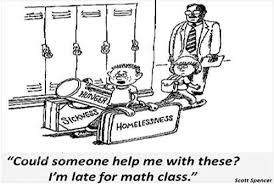
This cartoon set the tone for our time in New York. It depicts a young boy in a school hallway, struggling to carry three heavy bags labeled Hunger, Sickness, and Homelessness. Just behind him, an adult appears unaware of the weight the student is carrying or unsure how to help. The child wants to learn and get to math class, but the burdens he carries make it harder to show up ready to learn.
Without intentional systems to understand and support the whole child, adults may see only the late arrival, the missing homework, or the head resting on a desk. Rather than recognizing the challenges behind these behaviors, students can be labeled, and opportunities can be taken away.
That's the challenge community schools are designed to address. By bringing people, partners, and resources together around students and families, community schools help ensure that children aren't left to navigate significant barriers on their own. Centering student and family experiences and voice is essential to this work—and it was a theme we returned to throughout the conference: You can't help a child with a burden you can't see.
Building the Foundation
Conference sessions mapped to NCCS's Essentials for Community School Transformation, a framework that illustrates how the different elements of a community school work together to create conditions where all students can flourish in thriving school communities.
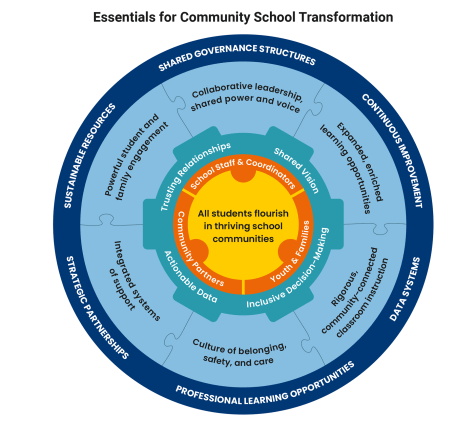
The framework is organized around several interconnected components:
The Goal: At the center is the shared vision of thriving school communities where all students can flourish.
People and Enabling Conditions: School staff and coordinators, youth and families, and community partners drive the work. Four essential conditions support their efforts: trusting relationships, a shared vision, inclusive decision-making, and actionable data.
Six Key Practices: These bring the community schools strategy to life. Conference sessions explored creating a culture of belonging, safety, and care; engaging students and families; building collaborative leadership and shared power; connecting learning to students' lives; expanding learning opportunities; and developing integrated systems of support.
Supportive Infrastructure: The outer ring represents what sustains the work over time: shared governance, data systems, strategic partnerships, and sustainable resources. Sessions on logic models, messaging, advocacy, and sustainability explored ways to strengthen these foundations.
One important takeaway from the framework is that these elements don't operate independently. Listening to students and families, for example, is only the beginning. Schools also need collaborative leadership, actionable data, strong partnerships, and sustainable resources to translate what they hear into meaningful action. Community schools aren't built around one program or intervention; they're built through relationships, shared responsibility, and the infrastructure to support lasting change.
Turning Insight into Action
For student support leaders, whether you run a community school, an MTSS team, or a counseling department, a few lessons travel well:
- Start by listening. The most effective teams begin by asking students and families what they need before designing solutions. Their experiences should inform the priorities and decisions that shape the school community.
- Make the invisible visible. Students don't always have the words, confidence, or opportunity to communicate what they're experiencing. Creating consistent ways to hear from students, gather input, and understand their experiences helps adults recognize needs that might otherwise go unnoticed.
- Look beneath the behavior. Attendance, disengagement, changes in classroom behavior, and difficulty focusing can all be signs that a student is carrying something beyond what adults see. Rather than treating these behaviors in isolation, teams can use them as opportunities to better understand what a student may need.
- Make belonging foundational. When students feel known, valued, and connected, they have firmer ground to stand on. Belonging strengthens the relationships that support well-being, learning, and participation in school.
These lessons are close to our hearts at Sown To Grow. They're why we built our work around regular student check-ins: when students have a simple, consistent way to share how they're doing, educators have more opportunities to recognize emerging needs, start meaningful conversations, and connect students with appropriate support. Student voice is most powerful when it doesn't stop at being heard, but helps shape what happens next.
Looking for ways to strengthen student voice and well-being in your community school? Connect with our team to explore how Sown To Grow can support your efforts.