The Missing Layer in Many MTSS Frameworks: Student Voice

.png)
If you lead student support — MTSS, school counseling, social work, or a community schools initiative — you already know the promise of a multi-tiered system: catch needs early, match students to the right level of support, and watch fewer of them slip through the cracks.
You also know the quiet frustration that comes with it. Too often, the "early" in early intervention isn't actually in advance. A student surfaces on a report, a team scrambles to respond, and everyone senses the same thing: we probably could have caught this sooner.
The reason usually isn't a lack of effort or care. It's the data the system runs on.
When your best data is already old news
Most MTSS and early-warning frameworks lean on a familiar trio: attendance, behavior, and course performance — the "ABCs," as coined by the U.S. Department of Education. There's good reason for that. Decades of dropout research, much of it from Johns Hopkins's Everyone Graduates Center, established these as among the strongest predictors of whether a student stays on track to graduate, and the federal Forum Guide to Early Warning Systems built entire frameworks around them.
But here's the catch: attendance, behavior, and grades are lagging indicators. A run of absences, a discipline referral, a failing grade — each is a record of a struggle that has already happened. By the time a student appears on the report, the thing you hoped to prevent is often well underway.
Think of it like a smoke detector versus a fire. Waiting for the ABCs to flag a student is a little like waiting to see flames before you evacuate the building. The signal is real — but it arrives after the damage has started.
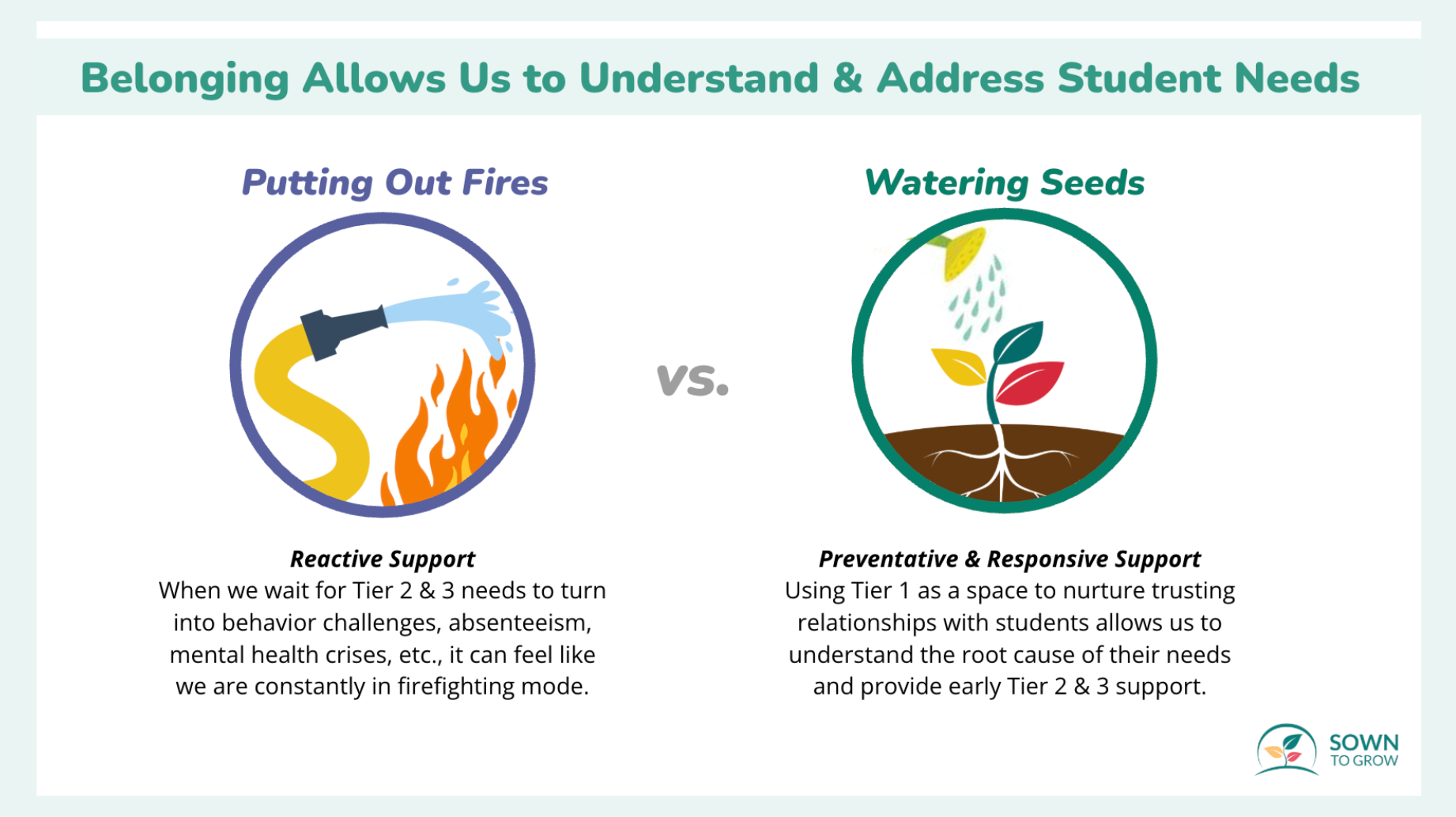
So the question for anyone building a genuinely proactive MTSS is simple: What data would tell us a student is struggling before it shows up in the gradebook or the attendance log?
The signal that arrives first: student voice
The answer is often sitting in plain sight — in the students themselves.
Long before a student's grades slip or their absences pile up, something quieter shifts: how they feel about school, whether they feel they belong, whether there's an adult they trust. Those feelings are leading indicators. And students can tell you about them directly, if you build a consistent, low-stakes way to ask.
The research on why this matters is deep and consistent:
🌱 Relationships and connection are not a "nice to have." In their widely cited synthesis on the Drivers of Human Development, David Osher, Pamela Cantor, and colleagues conclude that relationships are "the key drivers" of learning and development.
🌱 Belonging is a genuine protective factor. The CDC defines school connectedness as "the belief that others at school care about you," and links it to lower rates of virtually every risk behavior it studies — alongside higher grades, better attendance, and higher graduation rates. Yet in the CDC's 2021 Youth Risk Behavior Survey, only about 61.5% of high schoolers reported feeling connected at school — meaning nearly four in ten did not.
🌱 Voice fuels motivation. The Quaglia Institute for School Voice and Aspirations found that students who feel they have a voice at school are "seven times more motivated to learn."
Put simply: emotional well-being and sense of belonging move first. They're the layer many MTSS frameworks skip — not because leaders don't value them, but because they've historically been hard to see at scale. Student voice is what makes that layer visible, and it's the heart of why listening to students works.
How student voice maps onto every tier
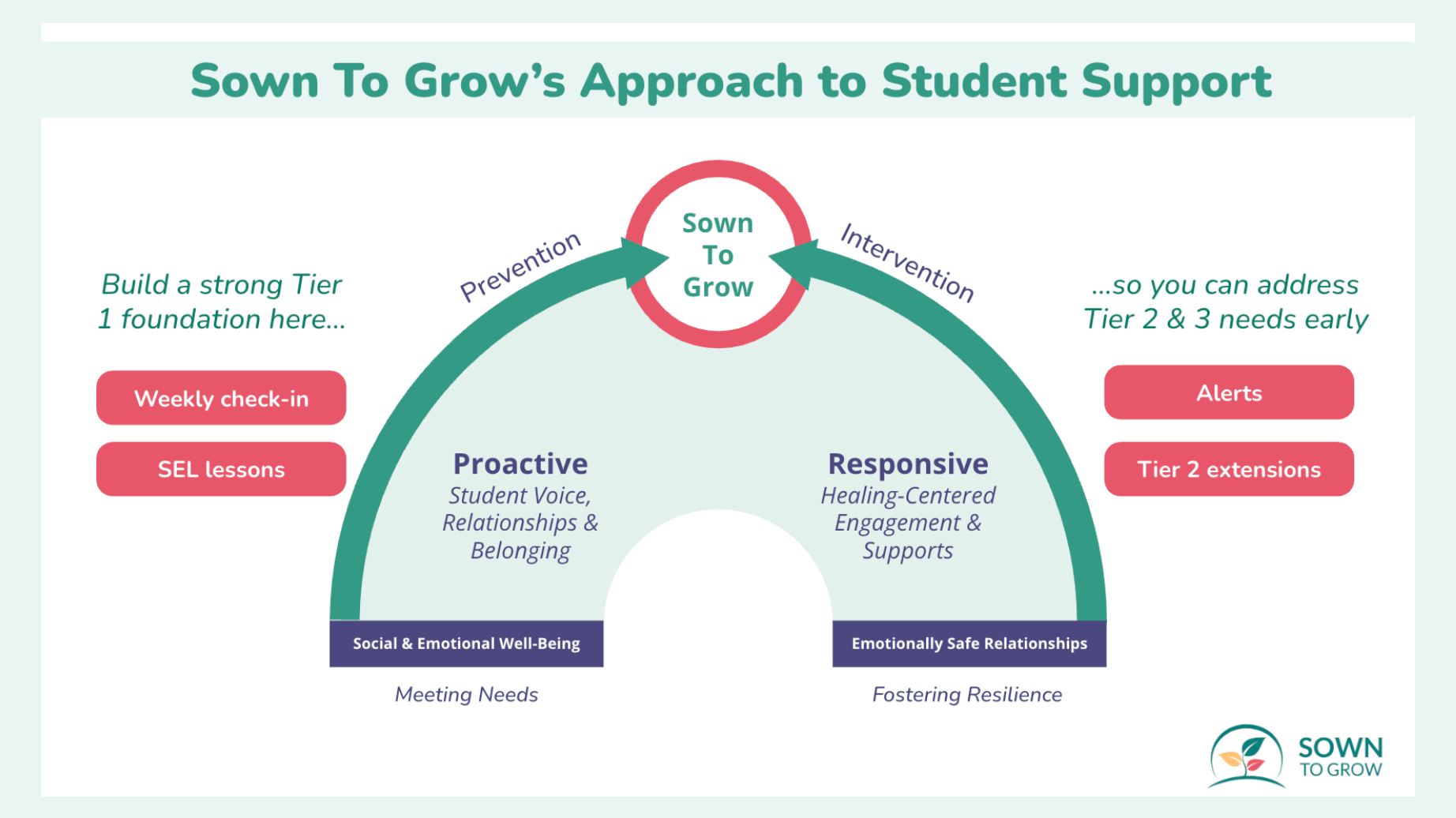
The most powerful thing about student voice data is that it doesn't sit outside your MTSS — it strengthens all of it. A single, universal listening routine can feed every tier:
🌱 Tier 1 (Universal): A simple, consistent check-in — How are you feeling? What's going on this week? — gives every student a voice and gives your team a real-time read on well-being across a class, a grade, or an entire school.
🌱 Tier 2 (Targeted): Patterns in that same data surface the students who need more: declining mood trends, a dip in sense of belonging, disengagement from reflections. Those patterns become the thematic small groups and targeted supports you build with confidence, because the need is grounded in the student's own words.
🌱 Tier 3 (Intensive): Concerning reflections trigger alerts that flag students who are quietly struggling — the ones "flying under the radar" that a behavior log might never catch — so a counselor or trusted adult can reach out right away.
As the team at Bigelow Middle School in Newton Public Schools framed it, student voice is "the data source that provides pathways to Tier 2 & 3." Build a strong, listening-centered Tier 1, and you don't just help more kids — you reduce the crush of reactive Tier 2 and 3 referrals that overwhelm student support staff.
What it looks like in practice
This isn't theoretical. Bigelow Middle School anchored its MTSS in a weekly student check-in through Sown To Grow, paired with an SEL screener and small-group supports. Teachers, counselors, and leaders read and respond to what students share. The data informs who needs a small group and who needs individualized support — and the load is distributed across the whole staff rather than resting on a single social worker or psychologist.
The through-line is a belief, not a dashboard. As (former) Principal Chassity Coston described it, caring about students means "taking their...social-emotional wellbeing into account first."
When that value is backed by real-time data, it becomes an operating system — and Bigelow went on to post higher SEL capacity than benchmark middle schools.
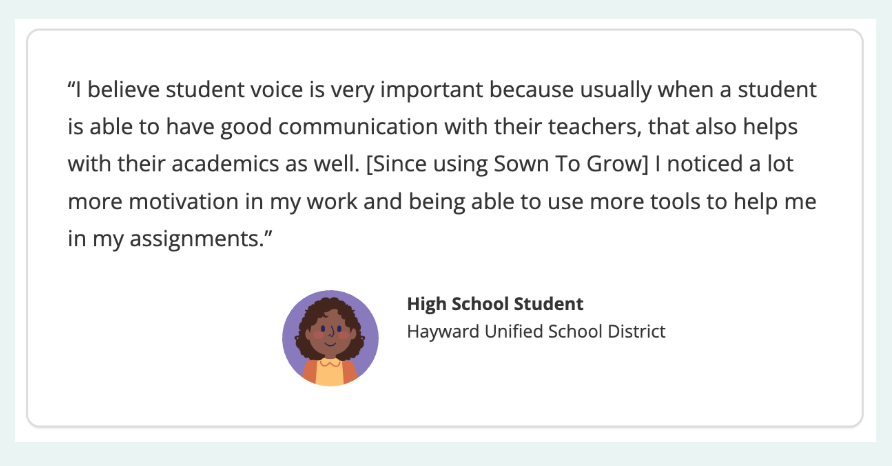
Students feel the difference, too. One Hayward Unified student told Sown To Grow that having a voice meant "a lot more motivation in my work" and more comfort at school. The check-in isn't a survey they fill out for the adults; it's a channel that gets them seen.
You don't have to rebuild your MTSS — just add the layer that listens
Here's the encouraging part: adding student voice doesn't mean overhauling your framework. It means giving your existing tiers an earlier, more human signal to act on. Start at Tier 1 with a consistent check-in, watch for the patterns that point toward Tier 2 and 3, and let students help you find the needs that attendance and behavior data would only reveal later — if at all.
Attendance, behavior, and grades will always matter. But they tell you where a student has been. Student voice tells you where they're heading — while there's still time to change the trajectory.
---
Curious what this could look like in your district? Sown To Grow helps schools make student voice the proactive engine of MTSS — universal check-ins, real-time well-being insights, and alerts that surface needs before they escalate. Meet with us to see it in action, or explore how Sown To Grow complements MTSS & PBIS.
.png)
.png)
.png)
.png)
.png)