Building What Works: How Research Shapes Product Development at Sown To Grow


Almost every edtech product claims to be research-based. Far fewer companies can show how they know their product works, or what they changed when the evidence said something wasn’t working.
A few years ago, I wrote a piece about how we develop logic models at Sown To Grow and how those logic models guide our feasibility and impact research. In that piece, I touched on how research is embedded in our product development process. In this post, I want to expand on that idea with real-world examples of how Sown To Grow has put this approach into practice.
First, a brief overview of some of the different types of research:
- Logic model: A map of the actions we expect educators and students to take with our product, and the outcomes existing education research suggests those actions will lead to.
- Feasibility study: A structured pilot to determine whether those actions are realistic in real classrooms, with real time constraints.
- Impact study: An analysis of student outcomes to determine whether using the product leads to the impact we expect.
Our journey - Sown To Grow’s Universal (Tier 1) Check-ins
Sown To Grow started as a universal protocol where students checked in on their academic progress and reflected on the strategies they were using, while teachers provided feedback and coaching. Early on, we saw strong connections between this reflective practice and social-emotional learning.
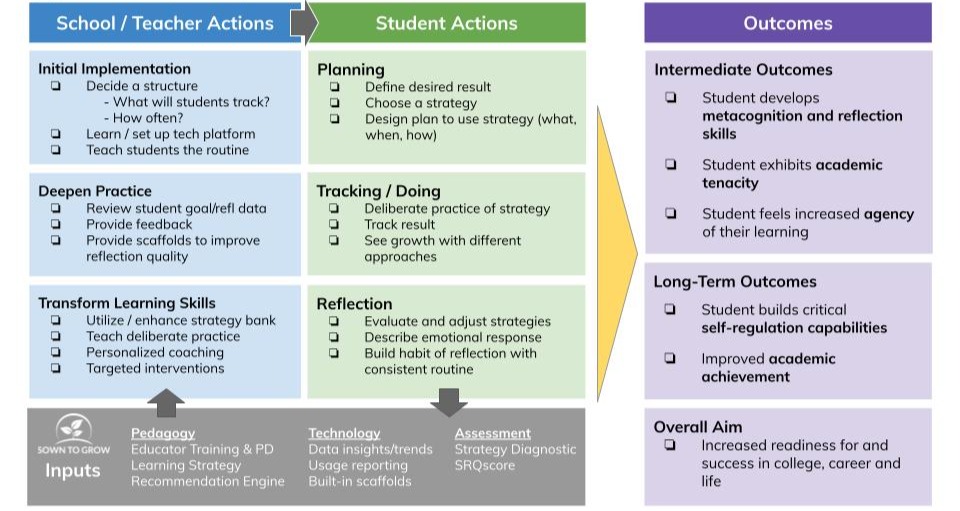
We began adapting our logic model and developing a prototype focused on student emotional well-being and SEL skill development.
With support from NewSchools Venture Fund, MBZ Labs, and WestEd, we reviewed the updated logic model and then conducted a feasibility study of the prototype.
Logic Model Review (MBZ Labs)
A research review of our initial logic model helped us expand our understanding of the research and existing literature, leading to an expansion of the teacher and student actions we sought to build into the product and a stronger confidence in the underlying research.
Feasibility Study (WestEd)
This study led to several improvements in the student interface, making it easier for students to read teacher responses and look back on their previous reflections. It also identified two barriers to effective implementation: teacher bandwidth and capacity for relationship building.
Those findings helped shape our next major investment. We recognized that finding the time to provide thoughtful, individualized feedback could be a challenge for teachers. So we built an AI/ML driven system that combines pedagogy and technology to suggest high-quality responses personalized to each student’s reflection. Teachers can use a suggestion as a starting point and make it their own. The goals were to save teachers time and to build their capacity to respond well. Through an Institute of Education Sciences (IES) SBIR Phase I project, we were able to partner with Leanlab Education to conduct a feasibility study on this new functionality.
Feasibility Study (Leanlab Education)
This study showed that this new system was effective at helping teachers provide more responses (often by providing a starting point that they could build off) and saved them time. Students found them authentic. The study also called out various accessibility improvements that could be made (such as simplified language options, talk-to-text and text-to-speech, as well as additional emoji options) that Sown To Grow implemented.
One of the other takeaways from the first research cycle was the opportunity to build a more comprehensive SEL tool. After a literature review, we expanded our logic model and added new functionality: a pre- and post-screener, weekly SEL lessons, and an adjusted check-in experience in which reflection prompts aligned with that week’s lesson.
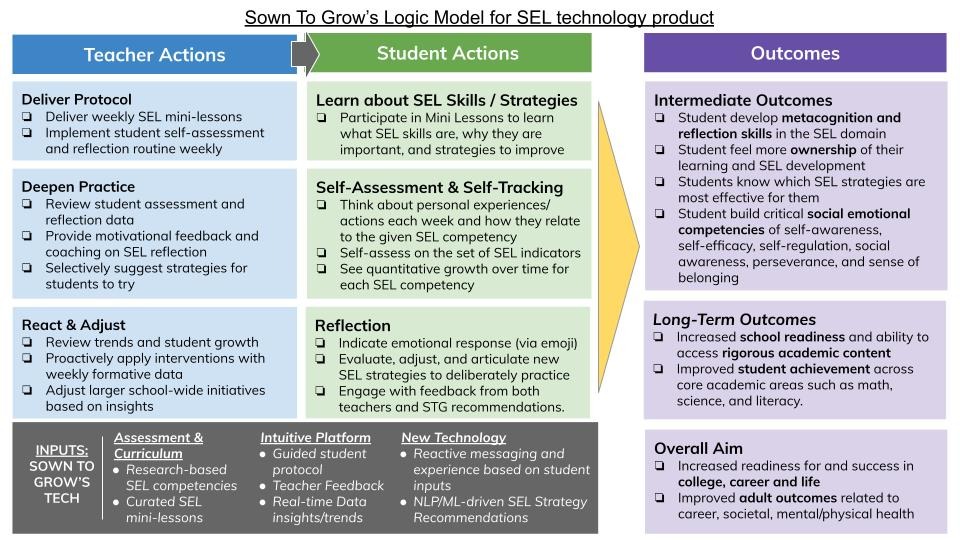
Through our IES SBIR Phase II grant, we partnered with Leanlab Education again to conduct a feasibility study and a full-year impact study.
Feasibility Study (Leanlab Education)
Teachers felt that the comprehensive SEL approach was feasible and led to deeper relationships with students, but there were some concerns expressed that the added time to deliver the lessons created a time crunch with also replying to student reflections.
Impact Study (Leanlab Education)
We conducted a year-long randomized controlled trial on the impact of this comprehensive SEL implementation. The study did not find statistically significant results. Researchers raised concerns about the study's validity, pointing to the sample size, the 10-month gap between pre- and post-study student surveys, and the number of survey questions. Together with what teachers had told us about time, it raised an important question: were we adding so much we were crowding out the part of the practice that mattered most?
These learnings, along with broader usage trends and user feedback, led us to change course. We made SEL lessons an optional weekly add-on for schools and doubled down on our core protocol: weekly student check-ins and teacher responses, along with beginning- and end-of-year SEL and belonging screeners.
Impact Study (Heubert Impact Research)
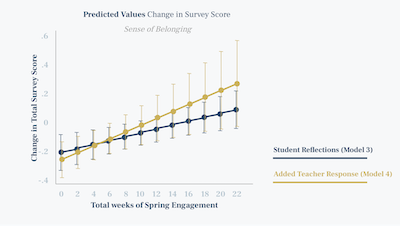
Next, we worked with an independent researcher on a larger quasi-experimental study of 26,763 students across 299 schools and 37 districts. The study found that students who reflected more often showed statistically significant growth in sense of belonging plue four SEL competencies: self-awareness, self-management, social awareness, and responsible decision-making. Teacher responses added value, especially for younger students’ sense of belonging. This study meets ESSA Tier 2 (Moderate Evidence) Criteria
Taken together, these findings reinforce the value of creating regular opportunities for student reflection and ensuring educators can use those insights to better understand and support their students.
What comes next
We believe this tight cycle of research and product development has been critical in building a universal check-in protocol with proven positive impact for students. It’s also, in our view, one of the most important ways to build technology for education responsibly.
We’re now using the same approach to build our Student Supports functionality. It helps counselors, social workers, and MTSS teams use what students share in Sown To Grow to identify students who need extra help and connect them to effective interventions. We’re excited to see what the research teaches us next.
Click here to explore more on our research and impact.